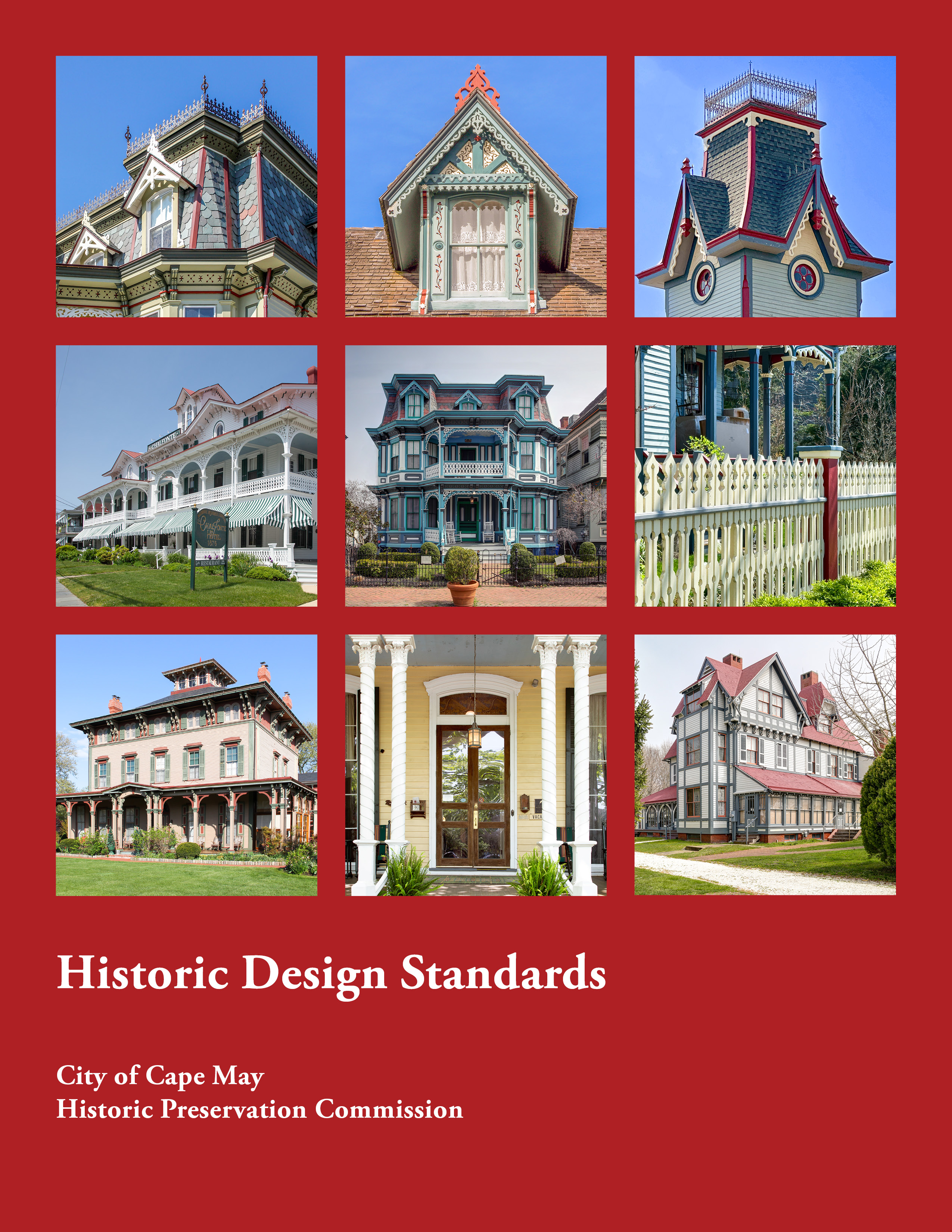
Historic Design Standards
Historic Design Standards
| Roofs
Exterior Cladding
Windows
Porch & Entrance
Doors
Sites & Streetscape
Storefront & Signage
Accessibility
Mechanical & Utility Equipment
Flood Mitigation
Additions
New Construction
Relocation
Demolition
|
Download Full Version
|
|
Introduction
The Cape May Historic Design Standards are an official document created by the Historic Preservation Commission to supplement The Secretary of the Interior's Standards for the Treatment of Historic Properties. The Design Standards apply to all structures within the Historic District and designated sites on the Zoning Map.
The Historic Design Standards safeguard historic buildings by guiding property owners and professionals. They address the concern of inappropriate modifications to character-defining architectural elements, which can undermine the integrity of the Historic District. While the Design Standards reflect Cape May's unique character, they may not cover every situation. Instead, they offer a framework for property owners, professionals, and the HPC to evaluate each project individually and develop solutions that align with the intent of the historic preservation ordinance.
Historic Design Standards
Do… | Do not… |
✔ Provide up-front guidance to property owners and qualified professionals ✔ Advance the historic character of the Historic District ✔ Prioritize design considerations and encourage appropriate alterations ✔ Improve quality and integrity of construction projects ✔ Preserve Cape May’s historic character ✔ Foster civic pride and awareness of Cape May’s history ✔ Provide criteria to consider prior to demolition | ✘ Enumerate specific standards or regulations for construction (Uniform Construction Code) ✘ Increase new construction or rehabilitation activities ✘ Regulate the density or location of development (Planning Board) ✘ Improve property maintenance (local ordinances) ✘ Regulate interior design ✘ Define business hours or means of operation (local ordinances) |
Survey Status
Properties in the Cape May Historic District are classified as either contributing or non-contributing depending on their age and historic character. The HPC reviews projects affecting both types and has developed stricter standards for contributing properties to maintain their historic integrity. The HPC Office maintains a list of contributing and non-contributing properties by address.
Contributing | Non-Contributing |
A building that meets specific criteria for historical significance within the Cape May Historic District, specifically: Was present during the Historic District's period of significance (approximately 1750 to 1948) Retains its historic character, meaning that its architectural style and features are still intact and have not been significantly altered Contributes to the overall historic significance of the Historic District, either by representing an important period of history or by being associated with a person or event of historical significance
| A building, site, structure, or object that does not add to the historic architectural qualities, historic associations, or archaeological values for which a property is significant because it: Was not present during the period of significance; Due to alterations, disturbances, additions or other changes it no longer possesses historic integrity reflecting its character at that time or is incapable of yielding important information about the period; Does not independently meet the National Register criteria.
|
What's my property's survey status?